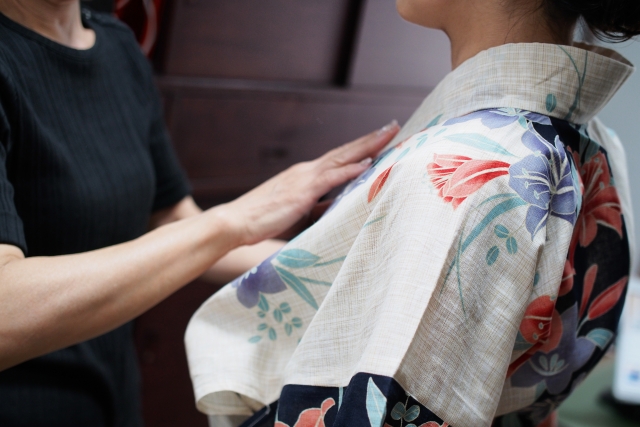
While there are many different cultures in the world, the Japanese kimono is widely known as “KIMONO” as it is. The colorful and delicate kimono is glossy, beautiful, and elegant. When you visit Japan, you may want to take a picture with a woman wearing a kimono! Or maybe you would like to try it on! I am sure that there are some people who would like to try on a kimono. By the way, did you know that in Japan there is a type of clothing called yukata that looks like a kimono? Yukata is often worn at summer festivals, and although it looks like a kimono, it is a different type of clothing. We will explain the difference between a yukata and a kimono, so please enjoy the kimono more with prior knowledge!
Kimono and yukata are completely different in terms of history
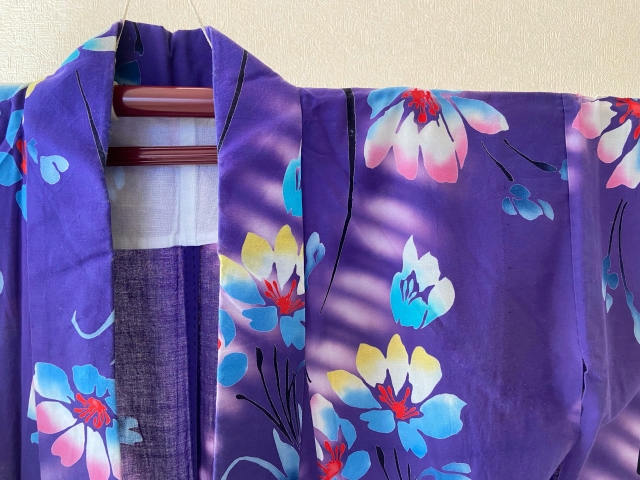
Although yukata and kimono look very similar, there are actually many differences in materials and occasions when they are worn. The differences in TPO (time, place, and occasion) are derived from the history and origins of both kimonos and yukatas.
Both kimonos and yukatas were originally called “kantougi,” a type of clothing worn by women during the Yayoi period (710-794). This was worn by women during the Yayoi period (710-794), when a hole was cut in the center of a piece of cloth and the garment was worn over the head. From there, the form changed with the times, and the garments that became the basis of the “kimono” and “yukata” were born during the Heian and Muromachi periods.
The origin of the kimono is an undergarment called kosode, which was worn by women of high rank under the junihitoe (12-layered robe). In those days, they wore hakama over the kosode, and then a kimono was layered over it. In the Edo period (1603-1867), the “kimono + obi” style was established, and it is said to have become the daily wear of the common people. Later, after the Meiji period, Western-style clothes became the daily wear, and the kimono became the traditional costume.
The yukata is based on the yukatabira, which was worn by aristocrats when entering the steam baths that were the baths of the time. It was also worn as loungewear and nightwear, and as the culture of the bathhouse spread to the general public during the Edo period (1603-1868), it became popular as a kimono to be worn after a hot bath. Since it could be worn more loosely than a kimono, it became an everyday item of clothing, and is said to have become as casual as it is today.
Today, kimonos are often treated as formal luxury wear, while yukata are often treated as casual summer fashion.
Can you tell the difference between a kimono and a yukata by their appearance?

Nowadays, the kimono is a luxury costume and the yukata is a casual fashion, but if you compare them, they are quite different in appearance.
First of all, it is easy to tell the difference in appearance because of the difference in materials. Kimonos are generally made of pure silk (silk) and yukata are generally made of cotton. Kimonos are made of high-grade fabrics, which are often smooth to the touch and have a graceful sheen. Today, yukata are also available in polyester and other materials that are easier to handle.
Yukatas are not lined, while most kimonos are lined. When dressing, a yukata can be worn over a kimono or underwear, while a kimono requires undergarments called hikabintuban (underwear) and nagabintuban (long underwear) to be worn under the kimono. Therefore, the kimono is more formal, while the yukata gives a cooler impression. You can also distinguish between a yukata and a yukata by whether or not you can see the long underwear at the collar.
There are also differences in the obi and footwear. A yukata has a short, thin obi, while a kimono is wrapped with a thicker, more luxurious obi. The yukata obi is usually worn with a han-haba obi or hyōgo obi, while the kimono is tied with a nagoya obi or fukuro obi, and fastened with an obijime and obiage, both of which are small accessories. The difference in footwear is that kimonos are worn with tabi socks and sandals, while yukatas are worn barefoot with geta (wooden clogs).
The difference in patterns is another easy-to-recognize distinguishing point. Kimono patterns are imbued with meanings and wishes, led by auspicious patterns called kosho-mons (auspicious patterns). For example, the pine, bamboo, and plum blossoms mean “brightness of life and strength,” cherry blossoms mean “wish for a bountiful harvest and celebrate new beginnings,” arrow feathers mean “ward off evil,” and butterflies mean “rise to power. Many yukata patterns are more flamboyant than kimono or use summery patterns. Since yukata are often worn at night, such as at festivals and fireworks displays, many yukata use colors and patterns that look good at night. Also, since yukata are worn in summer, many yukata have summer flowers, fireworks, fans, goldfish, and other summery patterns on them.
What are the differences in seasonal and TPO manners?

We have already mentioned that kimonos are formal wear and yukatas are for everyday wear, but there are actually different types of kimonos. There are kimonos for everyday wear, such as komon and tsumugi, and kimonos for ceremonial wear, such as furisode and visiting kimono, for weddings and other occasions. You can go out in a yukata only in summer. Kimonos are worn during other seasons.
The difference between Furisode and Visiting Kimono and the Komon and Tsumugi of daily wear is that the patterns of daily wear kimono are the same all over the kimono, while the Furisode and Visiting Kimono have “Ewa pattern”, which means that the patterns near the hem are connected like a single picture.
In addition, furisode and visiting kimonos often use auspicious patterns. In recent years, kimonos with Western-style patterns have been on the rise, but many traditional furisode and visiting kimonos with classical patterns have pine, bamboo, plum, flower, or noshimete patterns written on them.
In addition, many kimonos, obis, obijime obiage, sandals, and other accessories worn with furisode and visiting kimonos have gold or silver threads, and the gold and silver threads look great when worn to ceremonial occasions.
Yukata is everyday wear, so it cannot be worn as formal wear, but there are no strict rules on how to wear it. You can wear a yukata with a long undergarment to make it look like a kimono, or you can wear a yukata with an obi decorated with lace, which is a modern style item.
Compared to the kimono, the yukata requires fewer items, and some people can dress themselves.
What are the different types of kimono?

There are many types of kimonos, but if you do not choose one that suits your TPO, you may be embarrassed or make others feel uncomfortable.
Tsumugi
While ordinary kimonos are decorated by dyeing or embroidering the fabric, tsumugi is made by weaving dyed threads to draw patterns. This traditional technique is so well known that it has been designated as an important intangible cultural asset of Japan! It is a kimono for daily use, but it makes you look good.
Komon
Komon is a type of kimono for daily use in which the entire kimono is decorated with a pattern. It is characterized by the kimono’s gorgeousness and elegance. There are three main types of patterns: “Edo komon” with detailed decoration, “Kyo komon” with large patterns, and “Kaga komon.
Iro-muji
This is a plain kimono with no pattern. It can be worn for everyday outings, of course, but if it has one crest, it can also be worn for events such as children’s graduation and entrance ceremonies and the Shichi-Go-San.
Visiting Kimono
A kimono with a design of feathers on the bust and hem, it can be used as semi-formal attire with three or one crest, and can also be used for casual occasions such as dinner parties.
Furisode
Furisode is the first formal dress for unmarried women. There are three types of furisode depending on its length: large furisode, medium furisode, and small furisode. The middle furisode is often worn at adult ceremonies, while the ko-zurisode is worn with the hakama style for graduation ceremonies.
KUROMONZUKI
Kuromontsuki refers to mourning attire. It is made of black cloth and has a total of five crests: two on the chest, two on the sleeves, and one on the back. The obi (sash) is a black, black mourning sash.
Uchikake
One of the wedding costumes worn by brides at weddings. The kimono is not fastened with an obi, and the hem of the kimono is drawn back, which is impressive. Shiro-muku”, the standard bridal attire, is a white Uchikake.
Conclusion
Kimono and yukata look the same at first glance, but they are completely different, and the more you know about them, the more profound and different they are. Please enjoy the differences as Japanese culture!