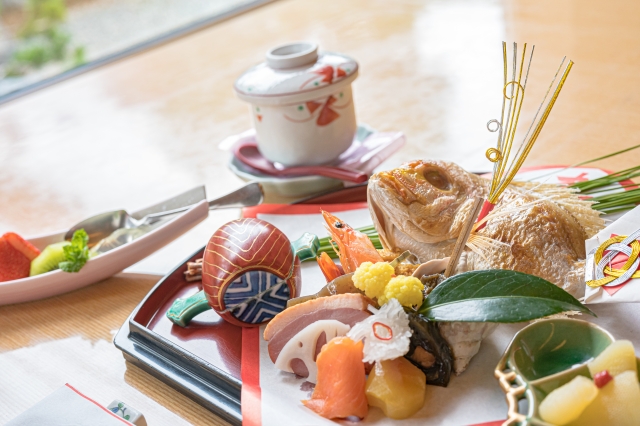
When you are asked what kind of cuisine is kaiseki-ryori, what do you imagine?
Is it a traditional Japanese dish? Is it a luxurious dish served at a ryotei (Japanese-style restaurant)?
Also, is there a difference between “kaiseki” and “kaiseki” with the same sound “kaiseki” and “kaiseki”?
If you want to taste proper Japanese cuisine when you come to Japan, knowing the characteristics of the dish will help you choose the right restaurant.
What is Kaiseki-ryori?

Kaiseki-ryori” today generally refers to the sumptuous Japanese course meals served at ryotei (traditional Japanese restaurants) and onsen ryokan (hot spring resorts).
Originally, kaiseki ryori originated in the world of the tea ceremony, where it was served to entertain guests.
Kaiseki ryori is said to have been started by Sen no Rikyu, the founder of the tea ceremony. Originally, kaiseki ryori was a simple dish served before drinking strong powdered green tea at tea ceremonies.
Kaiseki ryori expresses the wabi and sabi, the spirit of the tea ceremony, through its cuisine, which is based on the three main principles of “using seasonal ingredients,” “making the most of the natural flavors of the ingredients,” and “treating guests with care.
The menu is based on the basic Japanese cooking principle of “one soup, three greens,” consisting of rice, soup, three side dishes, and pickles. The three side dishes are namasu, nimono, and yakimono.
Since these dishes are intended to quell hunger before tea is served, they are usually served in modest portions and tend to avoid strong flavors, fried foods, and garish decorations.
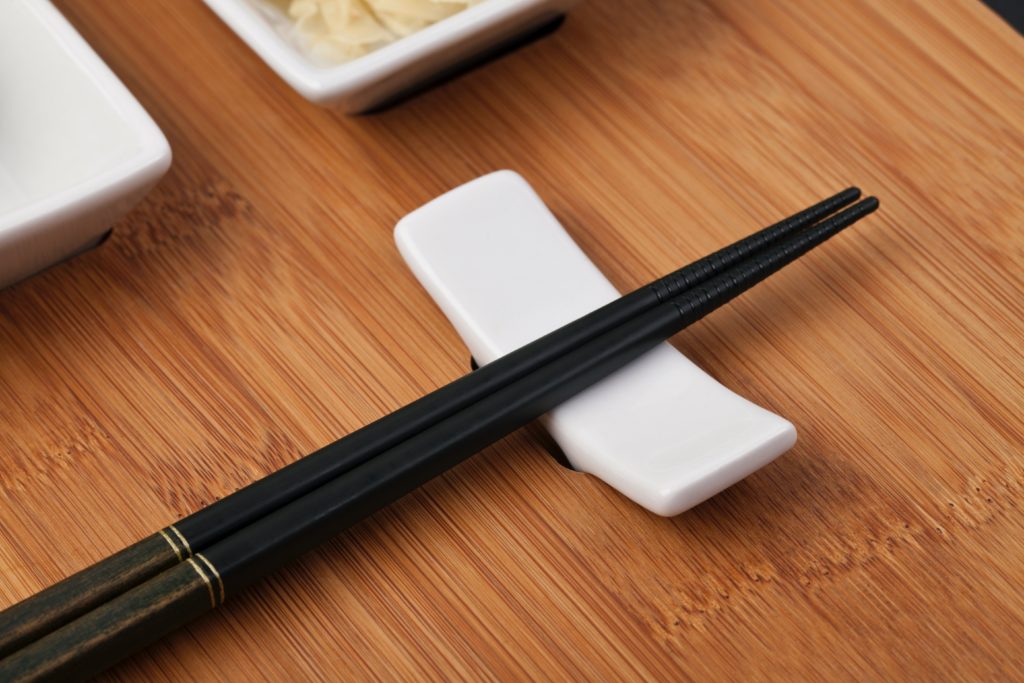
The etiquette during the meal is strictly regulated by each school of tea ceremony, and everything from how to place the chopsticks to the order of the meal and when to finish eating is done in accordance with these rules.
Compared to today’s kaiseki ryori, it is hard to imagine how simple the menu was when it first began, and there were many rules and regulations. It is said that the reason why kaiseki ryori became the sumptuous course meal it is today is because it developed apart from the tea ceremony and changed into a dish for sake banquets.
What is the origin of kaiseki cuisine?
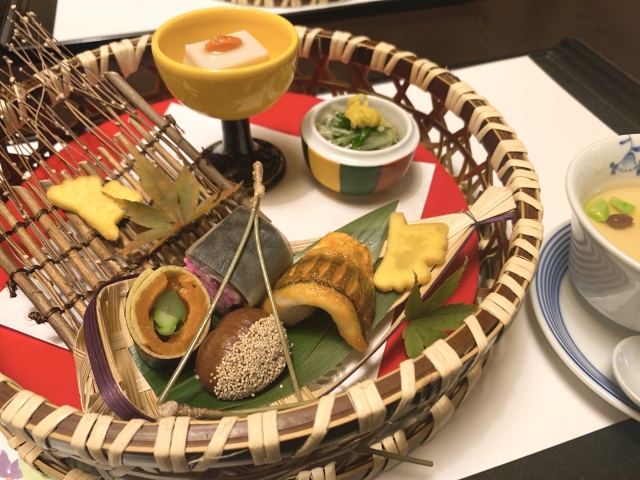
Many Japanese words can be associated with the meaning of a word based on the combination of the meanings of the kanji characters. However, it is difficult to associate the word “kaiseki” with a dish when looking at the characters. This is because the word “kaiseki” is made up of the kanji characters “懐” = “pocket” and “石” = “stone,” which are far removed from cooking.
There is actually a reason for this, and it is said to have originated from “onjaku,” which Zen monks used to carry in their pockets to quench their hunger. Onjaku is a stone that is placed in the belly or chest to warm the body, similar to a pocket warmer. Onseki not only warmed the body, but also alleviated hunger. Zen practitioners eat only one simple meal a day. If they do not eat enough, they do not gain fat and their bodies freeze in winter.
Therefore, it is said that they used Onseki to warm their bodies and stave off hunger. From this origin, the word “kaiseki” has two meanings: a stone to warm the body in the bosom, and a meal to alleviate hunger.
It is commonly believed that kaiseki is a simple dish served before tea in the tea ceremony. However, the Chinese character originally used in tea ceremonies was originally “kaiseki.
The character for “kaiseki” is said to have first appeared in the Nanbouroku, written by Tachibana Sanizan in 1690 (Genroku 3), 100 years after the death of Rikyu.
It is believed that Sanizan used this character to sound a warning against the tea ceremony of the time, which tended to be overly flamboyant.
In the Edo period (1603-1867), chakaiseki came to be called “chakaiseki” to distinguish it from “kaiseki ryori,” which was popular at ryori teahouses.
There are various theories about the origin of kaiseki ryori, and some say that Sen no Rikyu established kaiseki ryori by incorporating the spirit of Zen Buddhism into the tea ceremony during the Azuchi-Momoyama period (1573-1603).
Although there are some differences among theories, it seems common that kaiseki ryori originated from the hot stones used by Zen Buddhist ascetic monks.
What types of menu items are available in kaiseki-ryori?
What kind of menu does kaiseki ryori have?
Unless you are a tea ceremony aficionado, you probably do not have many opportunities to enjoy authentic kaiseki-ryori. In fact, kaiseki-ryori today is less and less recognized as “a meal for tea ceremonies,” and with the passage of time, it has changed to “a meal for enjoying sake.
Kaiseki dishes are as follows in the order in which they are served.
- Oshiki: rice, soup, mukozuke
- Wanmori (bowl) – rice, soup, mukozuke (mukozuke)
- Grilled food: ・・・・・・ Grilled fish
- Chopstick wash・・・・・・, small soup
5.appetizers・・・・・・・Snacks from the mountains and the sea
6.Yuubetsu・Konomono・・・Okoge with hot water poured over it, pickles - Main sweets and thick tea: Japanese sweets, rich tasting green tea
You may be wondering whether you will be able to eat all of this, but rest assured. Kaiseki cuisine is essentially a light meal eaten before enjoying the rich taste of matcha. Therefore, even though there are many items, each item is served in small portions, making it surprisingly easy to eat.
The rice, soup, and mukozuke that are served first are very small portions, and the rice is only a small bite. This is a polite way for the host to show his hospitality and say, “Thank you for coming.
Kaiseki cuisine consists of rice, soup, mukozuke, bowls, and grilled dishes, and is based on the concept of “one soup, three vegetables. Mukozuke is served with a variety of mukozuke, often featuring ingredients appropriate to the season. The soups and grilled dishes that follow are also often served with seasonal vegetables and fish.
What is the difference between kaiseki ryori and kappo-ryori?
Kaiseki ryori” has been mentioned several times before, but how does it differ from “kaiseki ryori”?
Those with a little knowledge may also wonder how it differs from “kappo-ryori”.
Let’s take a look at the differences between each.
What is the difference between kaiseki ryori and kappo-ryori?
First of all, there is a difference between “kaiseki ryori” and “kaiseki ryori. Both have the same sound as “KAISEKI,” but “kaiseki ryori” is banquet cuisine. Therefore, there are no strict rules for the menu. The number of items and their order varies. Fried or steamed dishes are sometimes served, and each person is generally served one dish at a time. The dishes are also decorated with seasonal flowers and vegetables.
In modern times, the term “chakaiseki” is used for meals served at tea ceremonies, while “kaiseki ryori” is used for meals served at ryotei (Japanese-style restaurants).
What is the difference from kappo-ryori?
What is the difference between kaiseki ryori and kappo-ryori?
If you want to eat proper Japanese cuisine, ryotei and kappo-ryori are recommended. Kaiseki ryori” is a type of Japanese cuisine that is served at a ryotei (traditional Japanese restaurant),
In kappo-ryori, you can enjoy kappo-ryori.
The difference between ryotei and kappo is the restaurant format. On the other hand, kappo serves Japanese cuisine at a counter.
In terms of price, kaiseki cuisine is often a bit more expensive because it uses more premium ingredients.
Know the difference and enjoy traditional Japanese cuisine!
Kaiseki ryori has been changing with the times into a “meal for enjoying sake,” but there is an easier way to enjoy it. It is called “Shokado bento.
Shokado bento is based on kaiseki cuisine, so the arrangement of dishes is the same as in kaiseki cuisine.
The menu is based on a “one soup, three greens” format that includes rice, mukozuke, soup, grilled dishes, and appetizers, allowing you to enjoy a variety of dishes in small portions.
There are many different types of traditional Japanese cuisine. Please enjoy the taste of Japan with its differences and characteristics!